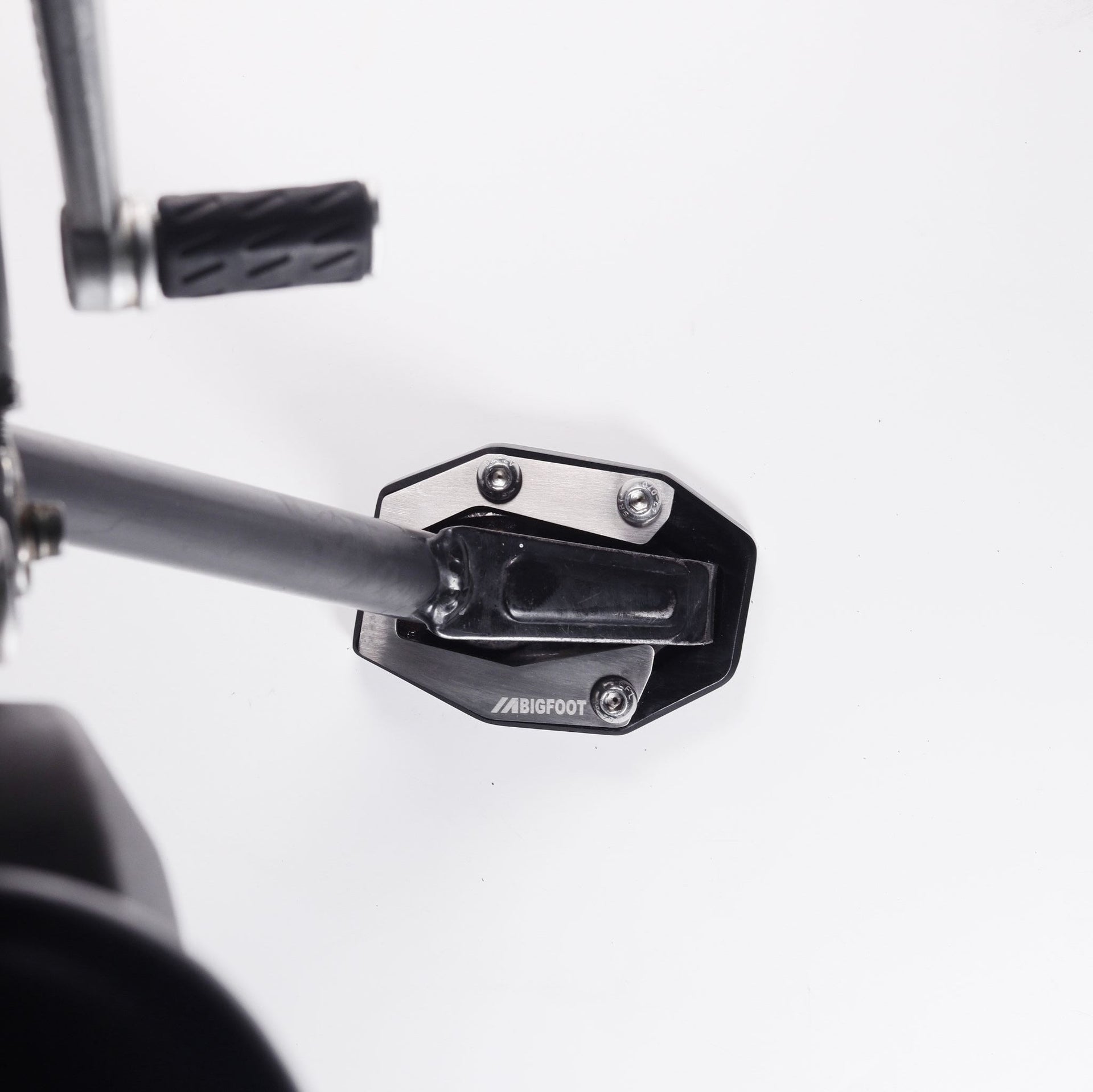
Why a Side Stand Extender (Bigfoot) Is One of the Smartest Accessories for Big Motorcycles
Every rider who owns a big motorcycle has faced this moment.
You park the bike.
It looks stable.
You walk away.
A few seconds… or sometimes a few minutes later — thud.
Your motorcycle is on the ground.
Most of the time, it’s not bad luck.
It’s not carelessness.
It’s the side stand sinking into the ground.
That’s exactly why a side stand extender, also called a Bigfoot, exists — and why it’s one of the most underrated yet important accessories for adventure and touring motorcycles.
What Is a Side Stand Extender (Bigfoot)?
A side stand extender is a metal plate that fits onto the bottom of your motorcycle’s stock side stand.
Its job is simple:
👉 Increase the contact area with the ground so your bike stays stable when parked.
Think of it like this:
Standing barefoot on soft mud vs standing with shoes on.
Same person, same weight — completely different stability.
Why Big Bikes Struggle Without a Bigfoot
Adventure and touring motorcycles today:
-
Weigh 200–270 kg (wet)
-
Are tall
-
Are often fully loaded with luggage
-
Get parked on unpredictable surfaces
Real-world parking spots are rarely perfect:
-
Gravel shoulders
-
Muddy trails
-
Broken road edges
-
Fuel stations
-
Dhabas
-
Hot asphalt
The problem is the OEM side stand foot is small.
All that weight is concentrated on a tiny patch of ground.
Result?
-
The stand slowly sinks
-
The bike leans more than it should
-
Eventually, the bike tips over
Most “parking falls” happen exactly like this.
“I Ride Only Highways” — That Doesn’t Save You
Even highway riders aren’t safe from this problem.
Highway reality:
-
Soft shoulders
-
Uneven fuel station floors
-
Hot tarmac that softens under weight
-
Sloped parking near cafés or viewpoints
Many bikes don’t fall immediately.
They fall after you walk away — which makes it worse.
How a Side Stand Extender Actually Works (Simple Physics)
No marketing tricks here — just physics.
Pressure = Weight ÷ Surface Area
-
Small side stand foot → high pressure → sinking
-
Bigger footprint (Bigfoot) → lower pressure → stability
A Bigfoot spreads the load, so the stand doesn’t dig in and the bike stays where you left it.
Bigfoot Is Also Important When You Climb Onto the Bike
This is something riders don’t talk about enough.
Many people climb onto big adventure bikes while the bike is still on the side stand — Beacuase one is supposed to
When you do this, extra weight and movement go straight into the side stand.
If the stand foot is small:
-
It sinks further
-
The bike leans more
-
The whole situation feels unstable
A side stand extender makes this much safer.
By spreading the load:
-
The stand stays planted
-
The bike feels steady
-
Mounting the bike becomes less stressful
This is a big confidence boost for big motorcycles like
Reduced Lean Angle = Easier to Handle Heavy Bikes
Another huge benefit of a Bigfoot is lean angle control.
Big motorcycles already lean a lot on the side stand.
When the stand sinks, the lean becomes excessive.
Why this matters:
-
A heavily leaned bike is harder to pull upright
-
On 230–270 kg motorcycles, that extra lean makes a big difference
-
It can feel genuinely intimidating, especially when you’re tired
A Bigfoot:
-
Slightly reduces excessive lean
-
Keeps the bike in a more manageable position
-
Makes lifting the bike off the side stand noticeably easier
This is especially helpful:
-
With luggage
-
On slopes
-
On uneven or soft ground.
-

When Is a Side Stand Extender Really Necessary?
🛣️ Touring
🔥 Must-have
-
Long rides
-
Unknown parking surfaces
-
Loaded bikes
🌿 Light Off-Roading / Adventure Riding
🔥 Non-negotiable
-
Gravel
-
Trails
-
Campsites
-
Forest roads
🪨 Heavy Off-Roading
⭐ Strongly recommended
-
Sand
-
Mud
-
Slopes
-
Remote terrain
If your bike weighs more than ~200 kg and leaves perfect tarmac, a Bigfoot makes sense.
Why Cheap or Universal Bigfoots Often Fail
Not all side stand extenders are the same.
Cheap or universal designs often:
-
Fit loosely
-
Rotate under load
-
Loosen over time and rattle while riding
-
Have sharp edges that dig into soft ground
-
Interfere with riding clearance
That’s why bike-specific design matters.
What Makes a Good Side Stand Extender?
Here’s what actually matters:
✔ Strong, corrosion-resistant metal
✔ Top + bottom clamping design
✔ Multiple bolts for secure grip
✔ Smooth, chamfered edges
✔ Balanced footprint (stable but compact)
✔ No interference while riding
Anything less is just decoration.
Machina Bigfoot — Built for Real Riding
Machina treats the Bigfoot as a parking safety system, not a cosmetic accessory.
The engineering approach:
-
CNC-machined 6061 aluminium main plate
-
2 mm stainless steel clamping plate
-
3 or 4 stainless button-head bolts, depending on side stand geometry
-
Clean edges to prevent digging into soft surfaces
Once installed, it’s something you stop thinking about —
until the day it saves your bike.
BIKE SPECIFIC DESIGN -

--- Bigfoot For Triumph Bonneville - A3
Common Myths Riders Still Believe
❌ “I’ll just use a stone or piece of wood”
→ Works… until it slips or sinks.
❌ “It adds unnecessary weight”
→ The added weight is negligible compared to the bike.
❌ “It’s only for off-road riders”
→ Most parking falls happen on roads, not trails.
Who Should Definitely Get a Bigfoot?
You should seriously consider a side stand extender if:
-
You ride a heavy motorcycle
-
You tour regularly
-
You park on unknown surfaces
-
You carry luggage
-
You’ve ever worried about your bike tipping while parked
In short — most adventure and touring riders.
Final Word
A side stand extender isn’t flashy.
It doesn’t add horsepower.
No one notices it at a traffic signal.
But it quietly protects your motorcycle every single time you park.
A Bigfoot isn’t an off-road upgrade — it’s everyday insurance for big motorcycles.