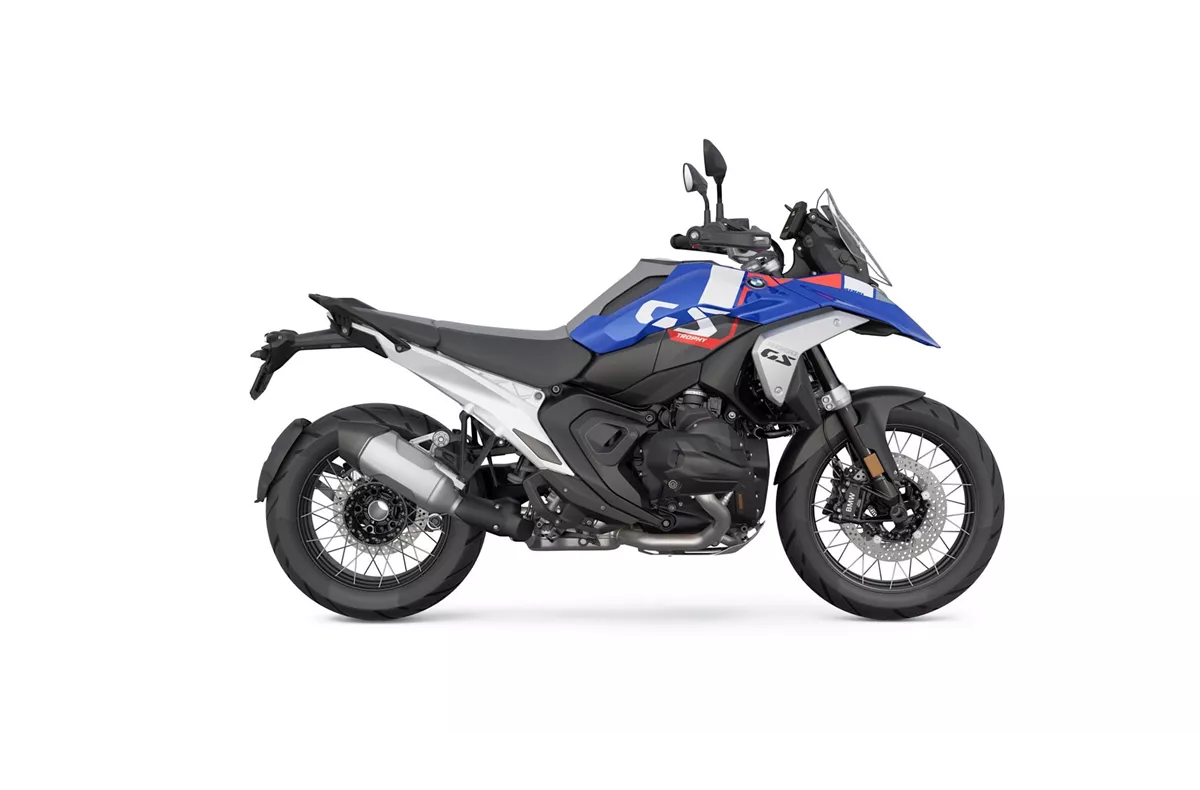
For over four decades, the BMW GS has defined the adventure-touring segment. Every generation refined the formula, but the BMW R 1300 GS goes far beyond refinement. It represents a fundamental shift in engineering philosophy, rider experience, and technology integration.
This is not just the next GS.
This is BMW Motorrad entering a new generation.
Here’s what truly makes the R 1300 GS a next-generation BMW Motorrad.
1. A Completely Reimagined Boxer Engine Architecture
At the heart of the R 1300 GS lies an all-new 1300 cc boxer-twin engine, redesigned from the ground up.
BMW has moved to a bigger bore and shorter stroke (shorter piston travel) engine configuration—an important change that defines the character of this new GS.
Why this matters:
-
Larger bore improves breathing and combustion efficiency
-
Shorter stroke allows the engine to rev more freely
-
Faster power delivery with reduced mechanical stress
This architecture makes the engine:
-
More responsive on highways
-
Effortless during overtakes
-
Less strained when touring with luggage or a pillion
BMW has also made the engine more compact and lighter, improving mass centralisation and chassis integration. Despite its sportier internal design, it retains the classic boxer DNA—strong low-end torque, smooth cruising, and long-distance reliability.
This shift in engine philosophy alone makes it clear:
the R 1300 GS is not an evolution of the 1250 GS, but a new generation altogether.
2. Significant Weight Reduction & Better Mass Centralisation
One of the most noticeable real-world improvements is weight reduction—nearly 12 kg lighter than the R 1250 GS.
BMW achieved this through:
-
A newly designed engine casing
-
A sheet-metal main frame replacing the tubular steel frame
-
An aluminium rear subframe
What this means for riders:
-
Easier low-speed manoeuvring
-
Less fatigue on long touring days
-
Better balance on broken roads and off-road sections
For a full-size adventure motorcycle, this is a major generational leap.

3. EVO Telelever – Fixing What Even the 1250 GS Got Slightly Wrong
BMW has long used the Telelever front suspension to solve one key problem in conventional motorcycles: excessive nose dive under braking.
On the R 1250 GS, the Telelever system:
-
Separates braking and suspension forces
-
Minimises front-end dive
-
Improves stability and confidence, especially during touring
However, BMW identified a subtle limitation during real-world use.
What BMW discovered:
-
The handlebars are directly coupled to the suspension via a ball joint
-
As the Telelever compresses:
-
The forks move upward
-
The handlebar angle tilts slightly forward
-
-
This isn’t unsafe, but it:
-
Affects steering feel
-
Becomes more noticeable with wide handlebars and long suspension travel
-
How EVO Telelever fixes this on the R 1300 GS:
-
BMW decoupled handlebar tilt from suspension movement
-
Steering forces are transmitted independently of suspension compression
-
Achieved using:
-
Bearings and pivots
-
Precision connectors
-
A flexible stainless-steel element that isolates unwanted motion
-
The result:
-
No handlebar tilt under braking
-
More natural and consistent steering feel
-
Improved front-end precision
-
Reduced fatigue on long touring days
BMW has retained Telelever’s biggest advantage—minimal nose dive—while eliminating its minor drawback, making EVO Telelever a true next-generation solution.

4. Dynamic Suspension Adjustment (DSA): Suspension That Thinks
The R 1300 GS introduces Dynamic Suspension Adjustment (DSA), a major upgrade over the Dynamic ESA system used on the 1250 GS.
What’s new:
-
Both damping and spring rate adjust dynamically
-
Continuous adaptation based on:
-
Ride mode
-
Road conditions
-
Riding style
-
Load (rider, pillion, luggage)
-
Optional Adaptive Ride Height Control further enhances confidence by automatically lowering the bike at slow speeds or when stopping.
For touring riders, this means:
-
Plush comfort on highways
-
Firm control on twisty roads
-
Stability on rough or uneven terrain
All without manual adjustment.
5. Smarter Electronics & Rider Assistance
The BMW R 1300 GS features the most advanced electronics package ever fitted to a GS:
-
Multiple riding modes
-
Cornering ABS and traction control
-
Radar-based Adaptive Cruise Control
-
Front Collision Warning
-
Optional Automated Shift Assistant (ASA)
These systems don’t remove rider involvement—they reduce fatigue, increase safety, and enhance long-distance comfort, making the 1300 GS feel like a truly modern Motorrad.
6. Design That Reflects Engineering Intent
The sharper, more compact design of the R 1300 GS is functional, not cosmetic.
Key benefits:
-
Slimmer bodywork for better rider movement
-
Improved aerodynamics
-
Optimised ergonomics for seated and standing riding
It still looks unmistakably like a GS—but one designed for the future.
7. Built for Real-World Adventure Touring
BMW didn’t build the R 1300 GS for extremes. They built it for how riders actually travel:
-
Long highway days
-
Changing road conditions
-
Heavy luggage
-
Occasional off-road detours
By rethinking the engine, reducing weight, refining suspension, and adding intelligent electronics, BMW has created a GS that is:
-
Easier to ride
-
Less tiring
-
More capable everywhere
A True New-Generation BMW Motorrad
The BMW R 1300 GS is not just a replacement for the R 1250 GS—it’s a statement of intent from BMW Motorrad.
-
New engine architecture
-
Lighter, more compact construction
-
Smarter suspension technology
-
Enhanced touring comfort and control
This is what defines a new-generation BMW Motorrad—and the R 1300 GS sets the benchmark for adventure touring motorcycles moving forward.